Coordination is the toll booth.
Every tool charges a coordination cost before you can study - get the link, agree a time, wait for replies. If it fails, you study alone.

I studied for my own boards at this hour. Every tool I reached for - video calls, group chats, study apps - assumed someone had already arranged the session. None were built for the student who wants to start right now, with whoever's around.
The window when competitive-exam students do the bulk of their studying.
Report their primary study time falls after 9pm.
Average daily study time during peak prep.
Sessions abandoned because an accountability partner couldn't be reached.
Every tool charges a coordination cost before you can study - get the link, agree a time, wait for replies. If it fails, you study alone.
Being on camera meant tidying the room, sitting up straight, looking productive. The accountability mechanism produced anxiety instead.
Tools were either fully structured (teacher schedules, students attend) or fully unstructured (a plain call). Nothing lightweight in between.
Scale explained why the problem mattered. The interviews showed where it actually broke: not during studying, but before the session could even begin. The market-size stats create context; the student conversations exposed the failure point.
The missing feature wasn't more tools. It was removing the dependency on other people's schedules.
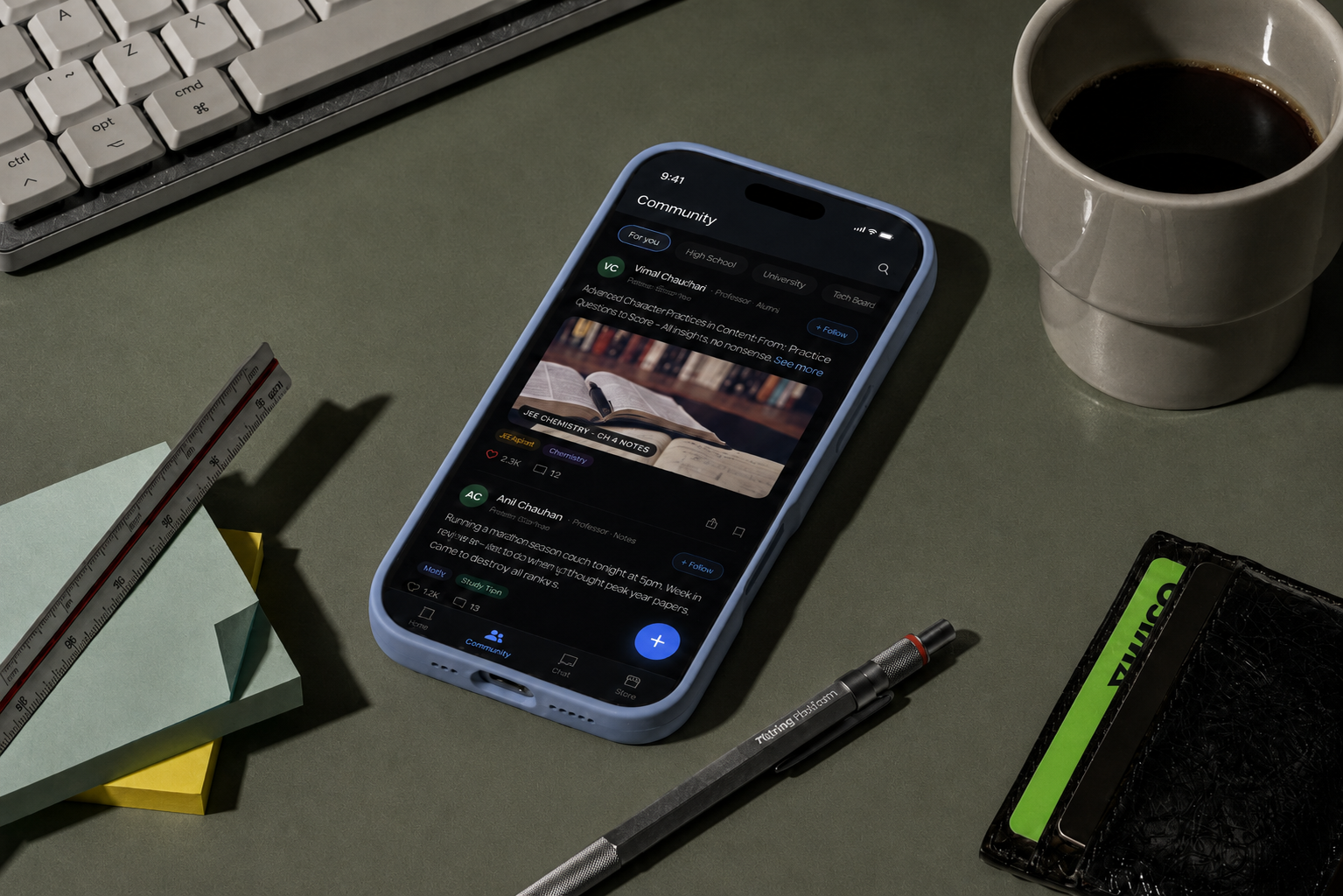
One question throughout: what does each tool assume must already be true before you can start studying?
Lokniti-CSDS and ASER 2024 data on exam-prep behaviour in India - to size the market and confirm the device.
India's private coaching industry - the infrastructure built around exam pressure.
EPW - Financial Express - 2024Students enrolled in coaching classes - a parallel education system.
India Coaching Federation - 2024Of 14-16s with smartphone access use it for studying. The phone is the device.
ASER 2024 - PrathamZoom, Meet, Unacademy, Discord - the tools students already reached for. The audit wasn't about features. It was about what each one needs to be true before it can open.
| Assumption required | Zoom | Meet | Unacademy | Discord |
|---|---|---|---|---|
| A session time has been agreed | ||||
| The group knows where to gather | ||||
| The student is comfortable being visible | ||||
| A study context exists before joining |
Read down any column and it's mostly amber. Every tool assumes the arrangement is already done. Zoom, Meet, Unacademy, and Discord solve the session layer, but they assume the hardest social work is complete: find people, align timing, share links, wait, remind, and restart momentum. The audit was not just that existing tools assume coordination. It was what that assumption costs: the student spends their limited willpower assembling the room before they can spend any of it studying.
Informal interviews on late-night habits, coordination failures, and camera discomfort.
"I'd spend 20 minutes in the group chat trying to get everyone online. Half the time I just gave up and watched YouTube."
"I always ended up cleaning my room before joining. Felt like I was performing instead of actually studying."
"I don't need my friends to be free. I just need to not feel like I'm studying alone at 1am."
"I still prefer studying with friends. I just wish it did not take so much work to get everyone there."
This mattered because Nest was not proving that friends were bad. It was proving that friends were fragile infrastructure.

Students were disciplined. They had the time, the intention, and a phone in hand. The blocker was always the same - needing other people online at the same moment.
No agreed time, no shared link, no waiting for friends. You walk into a room that's already live. Public rooms, full of strangers.
Friends were hard to coordinate. Strangers are hard to trust. So the rest of this product rests on a single bet - that a room full of strangers can do the work a friend couldn't. If that bet is wrong, Nest fails in a very specific way: a room full of people who are technically present but emotionally irrelevant. Attendance without accountability. A product that removes friends, but fails to replace the pressure they created.
Removing friends looks like a downgrade.
It's the opposite.
At the stranger end the two lines are farthest apart and flipped. That gap is the entire product.
“The stranger who shows up at 1:00 AM grants no permission to stop.”
We designed for social friction over casual comfort to drive user completion:
Remove the arrangement, and the rest of the product falls out of that single decision. Nothing here is a separate idea - each is what the move forces.
Made planning easier, but still depended on known people being free at the same time.
Reduced forgetting, but did not solve reluctance, silence, or last-minute drop-off.
Optimised the calendar, but not the social commitment needed to begin.
Kept the familiar model, but treated strangers as a fallback instead of the core accountability mechanism.
The chosen move was not to make friends easier to coordinate. It was to remove friendship as the condition for starting.
You don't ask who's free. You walk into a room that's already live. The avatar stack and count do what the group chat used to - except 45 people already decided for you.
Every video tool opens by asking you to turn it on. Nest does the reverse, in the open. Made findable in settings, the choice is a concession. Put in the pre-join screen, it's the default - and a statement about what studying should feel like.
Open rooms, walk-in and walk-out, no history kept. The session timer and the live count create accountability without surveillance. You know others are there. No one is watching you specifically.
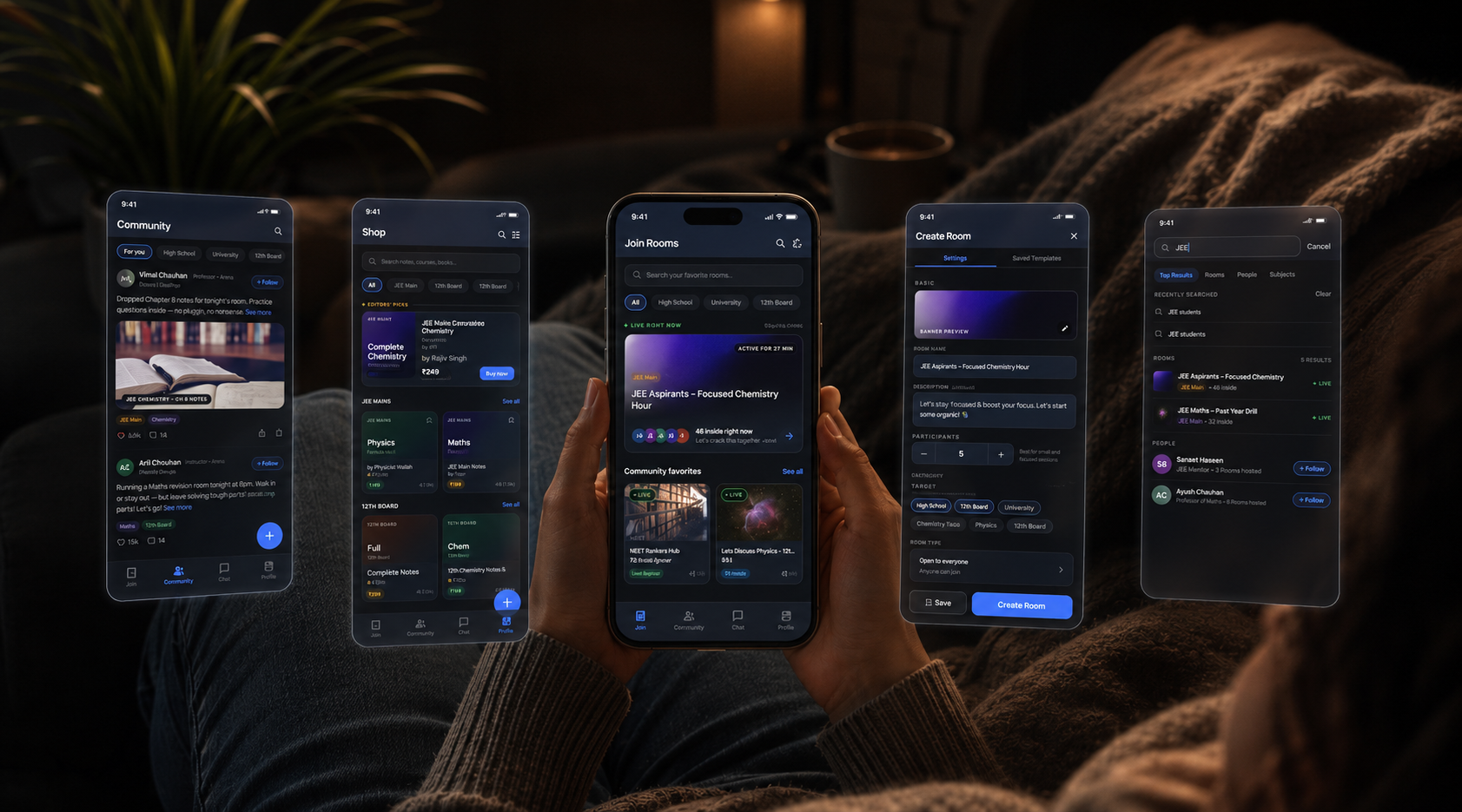
The build followed the product’s central bet: reduce the distance between wanting to study and entering a room that is already alive.
I mapped Nest around intent, not administration. The primary path had to move from ‘I want to study’ to ‘I’m inside a room’ before scheduling, invites, or setup could slow the student down.
The first sketches tested the full path before visual design: onboarding, room discovery, pre-join confidence, live presence, and the supporting tabs around it.
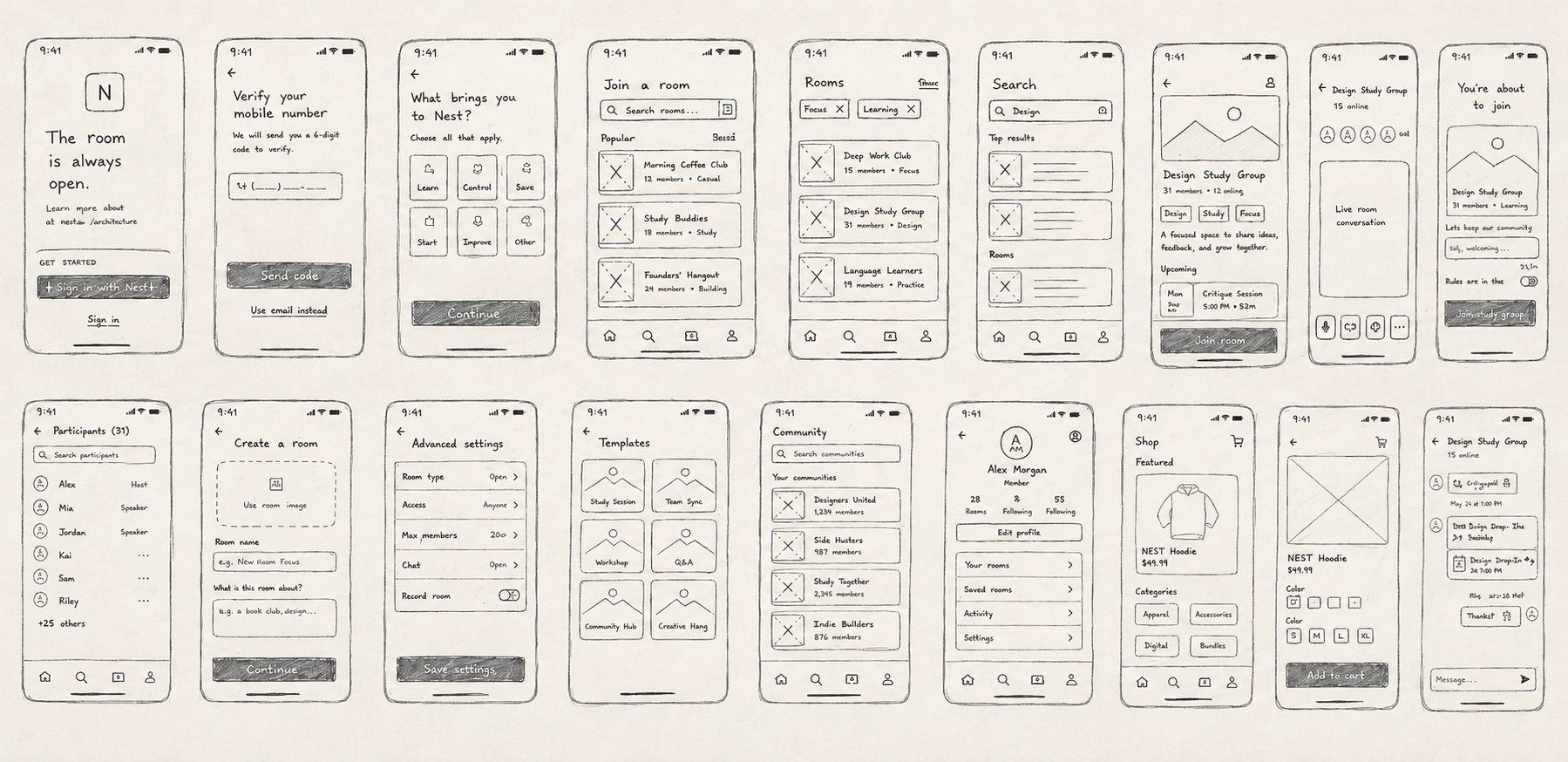
The wireframes locked the hierarchy: room first, proof second, controls last. At this stage, the goal was to judge the product logic without colour, polish, or interface styling carrying the idea.
The visual system turned the structure into a calm public-room interface: dark surfaces for focus, live cues for confidence, and controls that make camera use optional rather than performative.
The system had one belief: the room should feel alive without making students feel watched. Green is used as presence, not achievement. Dark surfaces make the interface feel like a room to settle into, not a dashboard to manage. Camera-off by default keeps accountability social without turning study into performance.
Live state is the first trust cue. It answers whether the room is active before the student reads any detail.
Avatar stacks and inside-counts make strangers feel less anonymous without requiring profiles to be heavy.
The CTA says “Walk in” instead of “Join” to make entry feel low-commitment and reversible.
Active, populated, ready to enter.
Room exists, but social proof is thin.
A valid stance, not a warning.
Blocked action with a useful next step.
Set expectation before asking commitment.
Timer, presence, and quiet controls.
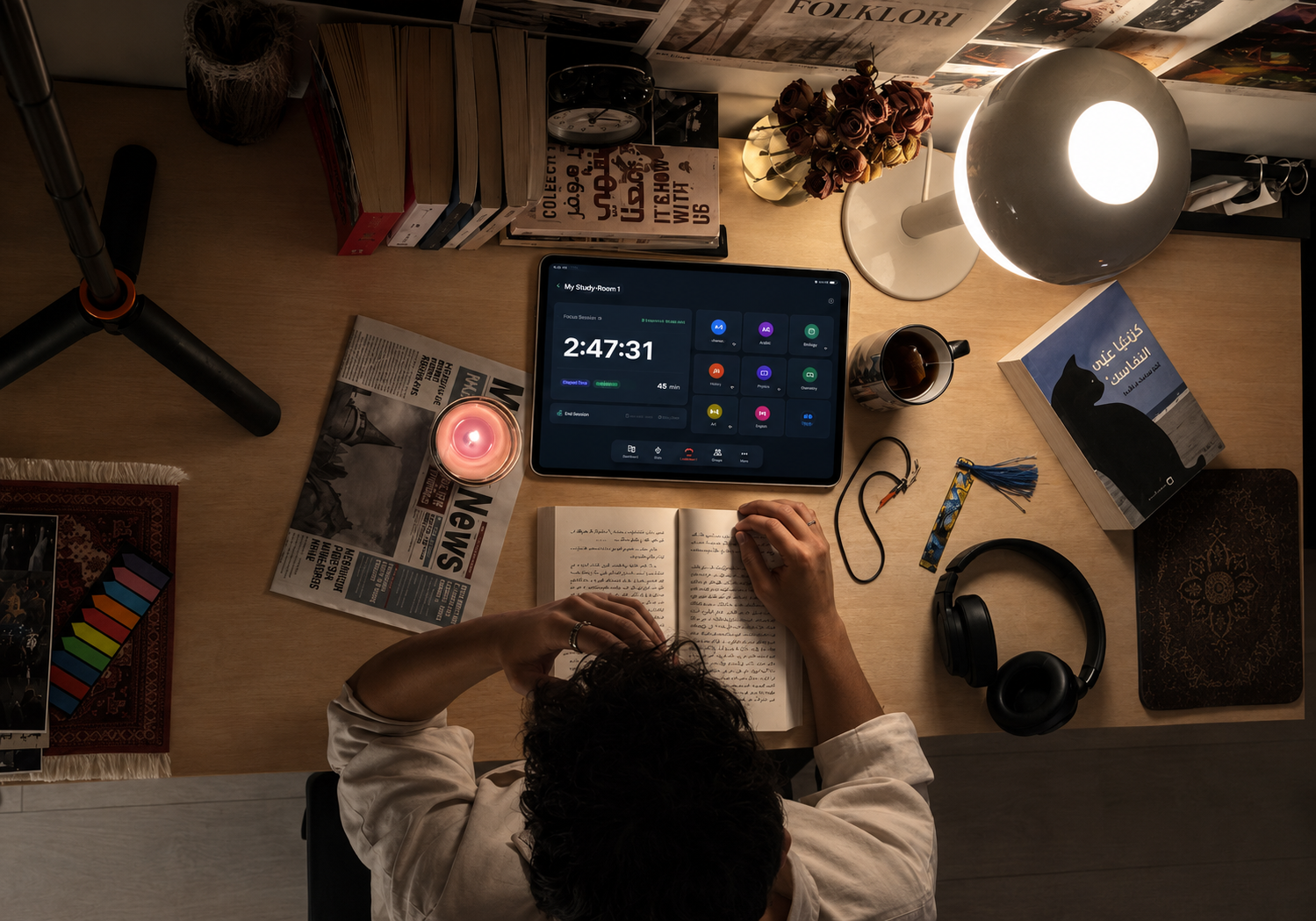
The rest support it. So this section shows the core screens without making you click through the whole product.
The room is already live. The interface makes time, presence, and a light social count do the work that cameras and host controls usually do.
The room list answers the old question before the student asks it: who is already studying, and where can I enter now?
The camera decision is not buried in settings. Nest says it out loud before the student joins, which turns privacy into a default rather than an apology.
The biggest shift was realising that Nest did not need to become more social. It needed to become socially present without becoming performative. The danger was not only loneliness; it was overcorrecting into a room that felt watched. That changed the interface direction: camera-off by default, quiet presence signals, visible room activity, and fewer features that asked students to perform.
Putting the choice in the pre-join screen, the controls, and the room detail - rather than one buried toggle - turned a feature into the product's position on what studying should feel like.
A public room with three people in it is worse than no room. The whole model depends on density - enough students online at once for rooms to feel alive. Design can't solve that alone; it needs seeding, probably educator-hosted daily rooms, before organic activity sustains itself.
JEE chemistry, board papers, physics notes - it works for the 80%. A design student, a law aspirant, anyone non-STEM finds nothing. Nest claims to be for all students; a section of it doesn't yet deliver on that.